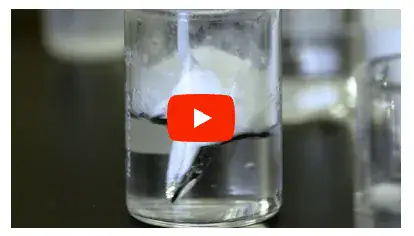
Hydrophobic silica is a specially modified form of silicon dioxide (SiO₂) particle, where the surface has been chemically treated to make it water-repelling (hydrophobic).
Regular (hydrophilic) silica has many silanol groups (Si-OH) on its surface, which attract and interact with water molecules. To create hydrophobic silica, manufacturers treat the surface with reactive silanes or other amino-silanes. Currently, AMS uses only polydimethylsiloxane to treat the surface of both fumed and precipitated silica.
These organic silane molecules react with the hydrophilic -OH groups, making the silica repel water instead of absorbing it.
AMS produces both hydrophobic fumed and precipitated silicas, and many of the finished parameters are determined by the hydrated precursor.
Key Differences Between Fumed Silica and Precipitated Silica
Fumed silica (also known as pyrogenic silica) and precipitated silica are both forms of synthetic amorphous silicon dioxide (SiO₂), but they differ significantly in production, structure, properties, and applications. These differences stem from their manufacturing processes, which influence their performance in industries like coatings, rubber, silicon elastomers, cosmetics, and food. Below is a detailed comparison in table form for clarity.
| Aspect | Fumed Silica | Precipitated Silica |
|---|---|---|
| Production Method | Produced via a pyrogenic (flame) process: High-purity silicon tetrachloride (SiCl₄) is hydrolyzed in a hydrogen-oxygen flame at temperatures around 1100–1800 °C, forming nanoscale particles in the gas phase. | Made through a wet chemical precipitation: Sodium silicate (water glass) is reacted with an acid (e.g., sulfuric acid) in aqueous solution, followed by filtration, washing, and drying. |
| Particle Size | Nanoscale primary particles (5–50 nm), forming branched, chain-like aggregates (up to hundreds of nm). | Microscale particles (5–50 μm), often more spherical and less aggregated. |
| Specific Surface Area | High (50–400 m²/g), due to fine particles, enhancing reactivity and thickening effects. | Moderate (50–200 m²/g), suitable for absorption but less extreme than fumed. |
| Density and Appearance | Low bulk density (fluffy, white powder), highly dispersible in non-polar systems. Often transparent in formulations. | Higher bulk density, more compact; typically opaque white powder. |
| Purity | Very high (>99.9% SiO₂), with minimal impurities due to gas-phase production. | Very high (>99.9% SiO₂), may contain traces of salts from the precipitation process. |
| Porosity | Low porosity, more solid structure. | Higher porosity, allowing better absorption of liquids or gases. |
| Cost | More expensive due to energy-intensive process and high-purity raw materials. | Less expensive, scalable wet process. |
| Key Properties and Performance | Excellent thickening, thixotropy, sag resistance, reinforcement, and anti-caking; high reactivity due to surface area. Better in high-performance applications. | Good for reinforcement and absorption; often used where cost and porosity matter more than extreme fineness. |
| Common Applications | Rheology control in paints, adhesives, sealants, cosmetics, and pharmaceuticals; anti-settling in inks and coatings. Also in silicone rubber for high tear strength. | Fillers in tires, rubber, toothpaste, and food (anti-caking); absorbents in agriculture and batteries. |
Fumed silica is finer, purer, and more suited for applications requiring superior rheological control and reinforcement, while precipitated silica is coarser, more porous, and cost-effective for bulk uses like fillers and absorbents. Both types of silicas are made at AMS.
Key Parameters of Hydrophobic Silica
Hydrophobic silica, a surface-modified form of silicon dioxide, has several critical parameters that influence its performance in applications like rheology control, anti-caking, defoaming, and hydrophobicity enhancement. Some important parameters are listed below:

Specific Surface Area (BET Method)
Measured in m²/g, this indicates the total surface area available for interactions. Higher values (typically 100–400 m²/g) enhance thickening and reinforcement properties but can affect dispersibility. The surface area is determined from the starting hydrated particle and the process of fumed or precipitated.
- Example ranges: 120–310 m²/g

Particle Size
Primary particle size is 4-15 microns for precipitated silica and 0.8-1.2 microns for fumed silica.

Bulk or Tamped Density
In g/cm³ or g/L (e.g., 0.04–0.06 g/cm³ bulk, 40–60 g/L tamped), this measures how compact the powder is. Lower densities indicate fluffier, more aerated particles, aiding in free-flow applications.

The pH Value (in Dispersion)
Typically 5.5–8.0 in a 4% aqueous dispersion. This affects compatibility with other materials; neutral pH prevents unwanted reactions in formulations like paints or adhesives.

Moisture Content and Hygroscopicity
Loss on drying (e.g., ≤0.5–0.7% after 2 hours at 105 °C) and low moisture uptake (<0.5 wt%) are crucial for hydrophobicity, ensuring the silica repels water and maintains stability in humid environments.

Loss on Ignition
Measures organic residues (e.g., ≤2–4% after 2 hours at 1000 °C). Lower values indicate higher purity after hydrophobic treatment.

SiO₂ Content
Purity level, often ≥99.9% based on ignited material. High purity ensures minimal impurities that could affect performance or safety in food/pharma applications.
Carbon Content
From the hydrophobic coating (e.g., 0.7–2.5% based on dried material). Higher carbon correlates with stronger hydrophobicity, as it reflects the extent of siloxane bonding with the particle.

Hydrophobicity Measures
Water Contact Angle (WCA): >90 ° (often 110–170 ° for superhydrophobic grades), quantifying water repellency. Higher angles mean better beading and non-wetting.
Surface Energy: Lower values (20–30 mN/m) enhance compatibility with non-polar systems.
Methanol Titration: Measures how resistant the silica particles are to wetting by water, which is a key indicator of the effectiveness of the hydrophobic treatment. Typical hydrophobic values are 40–80% for hydrophobic silicas.
Commercial Uses of Hydrophobic Silica
Hydrophobic silica, a water-repelling form of silicon dioxide, is valued for its ability to enhance water resistance, control rheology (flow and viscosity), act as an adsorbent, and improve product stability across various industries. Its surface is modified with organic molecule polydimethylsiloxane to repel moisture, making it ideal for applications where hydrophilic silica would absorb water and cause issues like clumping or degradation. Some of the uses are listed below.
Rheology Control and Thickening
Hydrophobic silica acts as a thickener, anti-sagging, anti-settling, and thixotropic agent in formulations to prevent dripping, improve stability, and control flow.
- In adhesives, sealants, and greases: Enhances viscosity and prevents separation.
- In paints, coatings, and inks: Provides sag resistance and improves application properties.
- In polar resins (e.g., epoxy, polyurethane, silicone, vinyl ester): Thickens without excessive viscosity buildup.
Anti-Caking and Free-Flow Agent
Hydrophobic silica is used to prevent clumping in powders by repelling moisture, ensuring easy handling and dosing.
- In food additives, animal feed, vitamins, and dry mixes: Maintains flowability.
- In pharmaceuticals (e.g., tablet powders) and toners: Reduces agglomeration.
- In fire extinguisher powders and plastic powders: Improves dispersibility.
Foam Control (Defoaming)
Hydrophobic silica breaks down or prevents foam formation in processes and products.
- In adhesives, paints, food processing, and powdered defoamers: Minimizes unwanted bubbles.
Adsorption and Carrier
Hydrophobic silica also adsorbs liquids, gases, or solids, converting pastes/oils into free-flowing powders.
- In aerogels: Enhances adsorption of organic pollutants or hydrophobic substances like oil.
- In composites and cable gels: Improves functionality and stability.
Reinforcement and Property Enhancement
This strengthens materials and improves mechanical properties like tensile strength, abrasion resistance, and weather resistance.
- In rubber and silicone elastomers: Increases hardness, tear strength, and crack resistance.
- In plastics (e.g., PVC, polyester resins): Acts as a filler for better durability.
- In coatings: Boosts hiding power, adhesion, and color modification.
Hydrophobicity and Surface Treatment
Hydrophobic silica can be applied to surfaces to make them water-repellent, creating rough, non-wetting textures.
- In construction materials or admixtures: Improves waterproofing.
- In personal care and cosmetics: Enhances water resistance and powder flow.
These uses can be both fumed and precipitated hydrophobic silicas.
AMSil™ Hydrophobic Precipitated Silica
Properties
| Product | Specific Surface Area (BET) (m2/g) | Average Particle Size (µm) | Bulk Density (lb/ft3) | pH | Form | Hydrophobicity Level |
|---|---|---|---|---|---|---|
| 35 | 120 – 140 | 6 – 7 | 8 – 9 | 8 – 9 | Powder | Standard |
| 35 FGK | 120 – 140 | 6 – 7 | 8 – 9 | 8 – 9 | Powder | Standard |
| 355 | 120 – 140 | 6 – 7 | 8 – 9 | 8 – 9 | Powder | Med high |
| 358 | 120 – 140 | 6 – 7 | 8 – 9 | 8 – 9 | Powder | Highest |
| 66 | 140 | 4 | 8 – 9 | 10.5 max | Powder | Standard |
| 66 FGK | 140 | 4 | 8 – 9 | 10.5 max | Powder | Standard |
| 665 | 140 | 4 | 8 – 9 | 10.5 max | Powder | Med high |
| 668 | 140 | 4 | 8 – 9 | 10.5 max | Powder | Highest |
| 70 | 100 – 110 | 7 | 8 – 9.5 | 8 – 9 | Powder | Standard |
| 70 FGK | 100 – 110 | 7 | 8 – 9.5 | 8 – 9 | Powder | Standard |
| 705 | 100 – 110 | 7 | 8 – 9.5 | 8 – 9 | Powder | Med high |
| 708 | 100 – 110 | 7 | 8 – 9.5 | 8 – 9 | Powder | Highest |
| 80 | 80 | 12 | 8 – 10 | 8 – 9 | Powder | Standard |
| 80 FGK | 80 | 12 | 8 – 10 | 8 – 9 | Powder | Standard |
| 805 | 80 | 12 | 8 – 10 | 8 – 9 | Powder | Med high |
AMSil™-F Hydrophobic Fumed Silica
| Products | Specific Surface Area (BET) (m2/g) | Average Particle Size (nm) | Tapped Density (g/1) | Moisture (wt%) | pH | SiO2 Content (wt%) |
|---|---|---|---|---|---|---|
| H22 | 130 ± 30 | 12 | 50 | ≤ 0.5 | 4.0 – 6.0 | ≥ 99.8 |
Hydrophobic Silica From AMS
AMS carries hydrophobic fumed and precipitated silica, along with a wide selection of other defoamers and chemical products. We collaborate with our customers at every step in the formulation process, from initial discussion through development, installation, production, and performance evaluations, to meet application-specific requirements.
Contact us today to connect with a member of our team and learn more about our capabilities.
